Showing posts with label plant-based. Show all posts

Monday, 14 December 2020

Cholesterol Metrics

What a difference a year makes... a year of dietary changes, mind you! I had my cholesterol tested at the end of September 2019. I was a happy carnivore and we had been using ghee (clarified butter) and coconut oil in our cooking (at my partner's request). Cause coconut oil and ghee are "good for you". Uh-huh. Not so much.

Here's my numbers from September 2019...

  • Cholesterol 7.10 - should be between 2.00-5.19 mmol/l - eek!!!
  • LDL 4.98 - should be between 1.50-3.40 mmol/l - nooooo!!!
  • HDL 1.48 - should be greater than 1.19 mmol/l - check!

So... while my HDL (good cholesterol) was good... the rest of the numbers were bad. Very bad. LDL cholesterol is the bad cholesterol and it was clearly in trouble. And let's not even talk about the total cholesterol number.

For Americans, who use a mg/dl system (still metric but different than Canada and the UK)...

  • Cholesterol 274 mg/dl - less than 200 is good, more than 240 is high
  • LDL 192 mg/dl - less than 100 is good, more than 160 is high, more than 190 is very high
  • HDL 57 - more than 60 is ideal, but 40 or more for men and 50 or more for women is acceptable

Sheesh... no wonder my doctor was freaking out and muttering things about statins and what not. Last year, after we got my results, I told him that I wanted to see what I could do with dietary changes and he agreed. He gave me three months... 

But... from September - December, we also went on a modified Keto/Paleo eating plan because a chiropractor (I know, I know!! Face-palm...) told us that it would be good for reducing my partner's inflammation and chronic pain. No carbs or sugars but eat as much meat and fats as you want. I don't even want to think what my numbers would have been in December.

Let's just say... the Keto/Paleo thing did nothing for inflammation and sent my gut into a tailspin. I even went and saw a dietitian at the hospital because my doctor thought I might be having a flare-up of IBS. The dietitian almost squeaked when she learned what we were eating and showed me all sorts of charts about the dangers of coconut oil and ghee. Not to mention the carnivorous diet we were on. Luckily... we were near the end of the grand Keto/Paleo experiment and... went back to normal eating in mid-December.

At the same time, we started reading a book by Dr. Michael Greger - How Not to Diet. We aren't normally diet people but... in trying to get the inflammation and chronic pain under control, we were experimenting with different eating plans. At the end of January 2020, we decided make a lifestyle change and embrace whole-food plant-based eating. No meat, no eggs, no dairy, no fish. No animal products of any sort.

We've been on that now for 10 months or so and I am 16 pounds lighter... and, had my cholesterol tested again in mid-November...

  • Cholesterol 4.76 - should be between 2.00-5.19 mmol/l - check!
  • LDL 3.01 - should be between 1.50-3.40 mmol/l - check!
  • HDL 1.11 - should be greater than 1.19 mmol/l - hmmm...

 And... in the American scale...

  • Cholesterol 184 mg/dl - less than 200 is good, more than 240 is high
  • LDL 116 mg/dl - less than 100 is good, more than 160 is high, more than 190 is very high
  • HDL 43 - more than 60 is ideal, but 40 or more for men and 50 or more for women is acceptable

My cholesterol metrics from 2014-2020

Right then... doing not too bad for LDL (bad cholesterol) and total cholesterol. The HDL (good cholesterol) is a bit low. I could start eating more good fats - olive oil, ground flax, avocado and... coconut oil.

I can already hear the people saying... "eat coconut oil - it will raise your HDL"! But... take a look at my HDL history... I was eating a tonne of coconut oil from 2018-2019 and... my HDL wasn't much better than in the previous years with no coconut oil. So... I'm not sure that's the solution.


The best way to raise my HDL is apparently high-intensity exercise three times a week. Or I could lose weight. Or I could quite smoking... except I don't smoke... I'm thinking that my HDL number is a reflection of an uptick in a sedentary lifestyle thanks to rainy autumn weather, no gardening activity and generally sitting around in front of the computer.

So, them's my options at this point. In the middle of a pandemic no less... Sigh. I think I see some interval training on beast hill coming up... maybe it's not enough to trudge up the hill once a day (8 minutes)... maybe it's better to go up 2 minutes, down 1 minute... up 2 minutes, down 1 minute... etc. And stutter my way up the hill... It certainly qualifies as high intensity... gasp... wheeze...

Monday, 17 August 2020

Film - Vegan 2019

Why go plant-based and animal protein free? So many reasons... some of which you may know... and some of which you may not. The film Vegan 2019 (on YouTube) offers a 51 minute summary of why...

The first bit looks at meat-substitute products like Beyond Meat and Impossible Meat which are going after the > 1 trillion dollar meat industry. There is quite a bit about how meat-free options are exploding into the market - from fast-food to corner stores to grocery stores to restaurants. The thing that kept coming to me is this... processed food... be it vegan or not... is not good for you. And... watch long enough and the film brings that forward as well. While processed vegan might be less harmful than processed non-vegan... it still can be harmful.

And then the film touches on the shift in dietary and nutritional recommendations, specifically mentioning Canada's new food guide which eliminated dairy and focused on plant-based foods. Despite the move toward veganism, there is push-back from carnivores (calling vegans fascists). But, even that push-back has made us aware of where our meat comes from, and the price that is paid, not just be animals, but by the earth, to feed our meat addiction.

The film even has several clips about Great Thunberg and her fight against the climate crisis. She is passionate about this... and the point that is brought forward is that the time for talking and discussing is done. It's time for action.

The 2019 film, The Game Changers, opened the floodgates for all sorts of athletes, body builders, actors, musicians and other celebrities coming out as vegans. And, not surprisingly, there was push-back from livestock producers, trying to promote their meat as healthy (grass-fed beef). And yet... grass-feed beef has an even bigger environmental impact than factory farming. Producers also tried to challenge some of the language used... arguing that the veg industry should not be able to use the words like "burger" and "milk". In Australia, the meat industry even tried to make a case for not using the word "slaughter" with regards to animals. Instead, they wanted to just used the word "process"... that animals are processed into food products. Riiiighhhhttt... And all of that just made the meat industry look desperate.

And let's be really clear here... getting enough protein is NOT the issue. Herbivores get lots of protein from the plants that they eat. And so can we. Ever seen the muscles on a rhino? They didn't get those by eating meat... but by eating plants. The bigger issue for the average North American is getting enough fibre. And fibre ONLY comes from plants... none from meat. And no... muscle fibre is NOT the fibre we are talking about.

The USDA dietary guidelines committee met to discuss the US food guidelines for 2020 and... the meat industry fought back... and all that does is lead to confusion. And then... in Europe... NFI developed a personalized diet which helped patients integrate plant-based nutrition and reversed Type 2 diabetes.

The film then looks at Fair Oak Farms which was like the Disneyland of agricultural farming. The film saw millions of people tour the farm and then... in 2019... abuse at the farm was exposed by an undercover animal rights group. Livestock farming is not a happy Disneyland experience... they are horrific, abusive places where sentient beings are tortured and slaughtered.

The year 2019 was also a huge year for fires, not only in Australia, but also in Brazil. Deforestation is a major problem and all of it to create farms to raise cows for people to eat. Many of the fires in the Amazon are set deliberately by cattle farmers... The thing to recall is... we are all in a burning building. 

Can we change fast enough though?

I found this film to be pretty good, even if there were short ads every 10 minutes. The world is changing and this gave me hope that we can make a difference, each one of us. The future is plant-based whole-foods... and, having been a rabid carnivore, I am continually surprised at how easy the transition was... if I can do it... anyone can do it...

Thursday, 30 July 2020

Eating by the Traffic Lights


What the heck is Traffic Light Eating? I asked the same question a few months ago when I came across the concept. It's really quite simple... Green Light foods can be eaten with wild abandon, Amber/Yellow Light foods should be minimized and Red Light foods... well, they should be avoided.

I kind of liked the little comment in the diagram at right: "Just like running red lights in the real world, you may be able to get away with it once in a while, but you wouldn't want to make a habit out of it." So true!

If we break it down a bit more...

Green Light Foods
These are unprocessed plant foods, as close to how nature made them as possible. Whole grains, beans, legumes, nuts, seeds, fruits, veggies, herbs and spices. Some green light diagrams also include eggs and lean meats in here, which is a bit confusing. Given how damaging animal protein can be to our bodies, I can see why they should be included in the yellow category.

Amber/Yellow Light Foods
These include a lot of processed foods, things like refined grains, burgers, fries, pancakes, hot dogs, pizza, sugary cereals, etc as well as unprocessed meats. This would also include dairy, eggs and meat and fish.

Red Light Foods
Here, we are into a lot of the oh-so-yummy things - soda, chocolate, chips, cookies, etc. and ultra-processed foods.

The thing that I noticed, as I reviewed different images of Traffic Light Foods is... things move around. As noted above... some plans have lean meat as a Green Light food while in others its an Amber Light food. Or burgers can be Amber or Red... Dairy moves around... Oil moves around... which really makes me wonder what Big Industry lobbies are behind these different schemes.

I found an article on The Washington Post that explains why Traffic Light Eating is not so black and white... or red and green. Which just makes me wonder if its a useful concept at all?

The image I've used above is from NutritionFacts.org, operated by Dr. Michael Greger (author of How not to Die and How not to Diet). He advocates eating whole food plant-based as much of the time as possible and dipping into the amber and red foods on occasion, but only if it helps to encourage eating the green light foods.

If sprinkling bacon bits on a salad helps you to eat the salad... then sprinkle away.

On the other hand... we made a choco-zucchini loaf the other day since we are starting to get buried under our super-productive zucchini plants. Flour, sugar, oil, cocoa powder and more than a cup of chocolate chips helped us to eat one cup of shredded zucchini. In this case... I'm not sure that eating all that red light stuff is helpful in promoting the consumption of one cup of zucchini... Greger has also published a short (7 minute) video about how he sees traffic light eating, which makes a lot of sense...

Traffic Light Food Labels

But there is another form of traffic light food... looking at the actual sugar, fat, salt, calorie content of the food. I've seen this more in the UK... not so much in Canada yet... although it is coming! The idea is that current nutrition labels on food are confusing to the general public. Who really has time to figure out what is healthy and not so healthy on a nutrition label... but... add in colours and put a summary on the front of the package and... it becomes much easier to figure out what is healthy and what is not.

So in the label at right... half a package of the product has really high saturated fat, low sugar and is moderate for salt, fat and calories. I would say... not a great food.

But then... who determines what is low, medium or high? I came across this chart from the UK which outlines how much fat, saturated fat, sugar and salt qualifies as low, medium or high.

But... me thinks that this is really only going to be applicable to processed foods... which, in general... are either Amber or Red Light foods to begin with. Sooo... is this helpful or not?

I mean... if I want a Kit-Kat... is a label like the one below really going to stop me? I guess.... maybe... If I have one once a week... That little two-finger Kit-Kat has that much saturated fat? What does a regular Kit-Kat have!!?


And then... we have something like this oh-so-yummy Starbucks Double Chocolate Chunk Brownie - pure decadent deliciousness... Starbucks has nutrition information on their site... but just a bunch of numbers... I know that 9 grams of saturated fat is probably in the red category (judging by the Kit-Kat numbers above)... But what about the rest? How does it fall in the grand traffic-light food labeling scheme? Sigh... As I feared... red light for Fat, Saturated Fat, Sugar and... yellow light for Salt (200mg Sodium = 0.55 grams of Salt). Luckily, I only have one of these a week but still... If I had to barrel past all those red lights every time I ordered one... I might reconsider it.

I decided to play around in Publisher and...created my own Traffic Light food label for a Starbucks brownie... if I saw this every time I ordered one... would I still order one every week?
It's a good question... In the UK, they seem to believe that front of label packaging helps people make healthier food choices... and... this might be the case here too... I'm going to guess that all whole food, plant-based items will get green lights across the board... the question will be... what will meat, dairy, egg and processed food packaging look like? Can't wait to see!

Tuesday, 21 July 2020

Meatless Meal Planning

We signed up for a meal delivery service a few weeks ago. This one is called FreshPrep, is based in Vancouver, and offers meals with no animal protein (no meat, fish, eggs or dairy). It's a bit of an experiment and we only get two meals a week but... we are trying to wrap our heads around tofu and... so far, things are going well.

Our first meal was Sweet & Spicy Tofu Stir Fry with Snow Peas, Mushrooms and Sriracha Teriyaki Sauce. We were a bit skittish about this meal since it had (a) tofu with which we have had bad experiences and (b) mushrooms which we both hate with a passion. But... we soldiered on and gave it a try. I cut up the tofu into centimetre chunks and while the recipe called for sliced mushrooms... I seriously diced them into near invisibility. What you can't see or chew won't hurt you! And.... as we gingerly chewed our way around the tofu... the verdict was... YUM!! We actually both loved it. The mushrooms were practically invisible and the tofu texture was palatable. Kind of like well-cooked chicken.

Our second meal with FreshPrep was a Spring Vegetable, Lentil & Quinoa Salad with Sweet & Spicy Cashews. Score two for two! It was seriously yummy as well and introduced us, in a nice way, to fennel. We had tried a fennel lemon salad (a la Jamie Oliver) a few years ago and found it... inedible. But... this version through FreshPrep was very good and we would definitely do it again.

See, that's the thing... you order these meals from the delivery service, figure out if it's yummy or not and then... you recreate it from scratch whenever you want... easy peasy way to try out new recipes and, for us, new ingredients.

We aren't 100% reliant on the meal delivery service... obviously. I've been trolling through the internet looking for good recipes and we had some plant-based recipe books from the library during the Covid-19 lock-down... so we have a good dozen recipes that are our go-to meals at this point...

Last week, when we gave away our stash of frozen meat, our friends asked us... but how do you plan a meal without meat? I get it... without meat at the heart of a meal... how do you figure out what to cook??? Well... we kind of go by what legumes we're in the mood for... or what flavours we are looking for. Do we want to go Mexican today? Or have a curry? Or maybe some sushi. A lot of it depends on how much time we have as well, since we eat our main meal at lunchtime. I don't want to spend most of my weekday mornings cooking... so we do a lot of cooking and freezing on the weekends.

Some of our favourites are:

Pita Tostadas with Butternut Squash, Black Beans and Avocado.
This recipe is super easy and super yummy... the biggest time factor is baking the butternut squash but... you only need about half a squash so we just bake it, mash it all up and then save the remainder for next-time tostadas. If you have mashed frozen butternut then whipping this together is a breeze.

We particularly like the freshness of the lime juice in the beans and the yogurt drizzle. And yes... we found that almond yogurt, while not really edible on its own, makes a good substitute for the drizzle.

A couple of tips... this is insanely messy to eat so we have learned to wrap the rolled-up tostadas in aluminum foil like they do with donairs... way less messy.


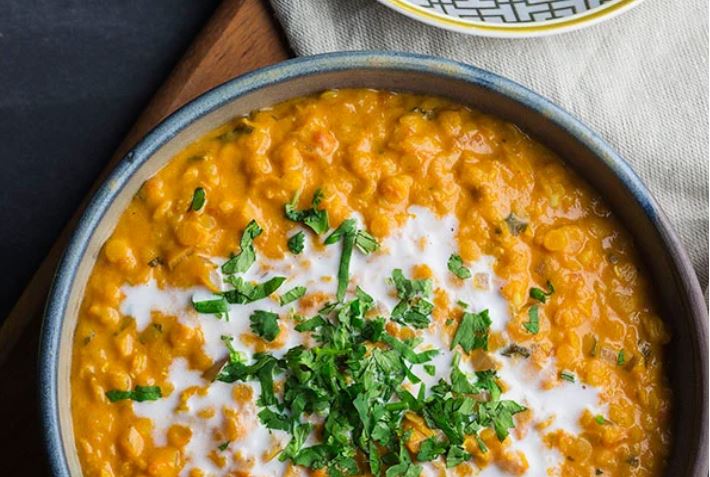
Coconut Curry Lentil Stew with Spinach & Currant Salad
We got this recipe from GoodFood last year. It is super yummy and one of our staples. We make it in a double batch and freeze the leftovers. It's relatively easy but one does need a few key ingredients like curry paste - which we buy in a jar (we use Patak's mild curry paste). We also go easy on the coconut milk as it is fairly rich in the bad saturated fats. We sometimes just put a tiny can in instead of the 400 ml can the recipe calls for... and we don't save any for the end. Red lentils are easy to cook with and don't require any soaking beforehand. Plus... we try to get a variety of legumes in our diet so... this ticks the red lentil checkbox! The recipe calls it a stew and serves it as a stand alone but we usually have it with rice or farro or some other grain.


Sweet Potato & Black Bean Enchiladas with Avocado-Cilantro Cream Sauce
This receipe came out of the Oh She Glows cookbook and is one of our standbys. [I couldn't find the real recipe online but there is a version of it here...]

It's a bit trickier to make because you have to make the enchilada sauce from scratch which takes extra time. We usually get at least two and a half meals out of this recipe so it's good value for time!

We love the avocado-cilantro cream sauce... which is just avocado, cilantro, lime juice whizzed up in the food processor with some salt and garlic powder. Again... the lime juice just adds a bit of vibrancy to everything.


Coconut Chickpea Curry
I found this recipe online and it has become one of our favourite staples. It uses Garam Masala as the main spice blend which you can buy in any store.

Again, we tend to go easy on the coconut milk and the recipe still works. It's super easy and quick as most of these curry recipes are. Just be sure to have a few cans of chickpeas and diced tomatoes.

We like to add chopped up cilantro and peanuts onto the tops of our curries. The cilantro adds a nice little burst of flavour and the peanuts add some nice texture.


Ultimate Lentil Walnut Loaf
Another recipe I pulled offline, also from Oh She Glows. while we didn't eat a lot of meat loaf back in the day... this lentil walnut loaf has become a serious staple in our lives. It freezes really well and defrosts quickly, so it's great for those days when you go "oh shit, forgot to take something out of the freezer". Mind you... it is seriously labour intensive - there is a lot of chopping and measuring involved in this. But... given that one loaf makes four meals (eight slices of loaf)... the time investment is worth it. The recipe says 40 minutes of prep time but that is not accurate... more likely an hour. It goes quicker if you have two sous chefs working away at prepping the ingredients.


https://camillestyles.com/food/pita-tostadas-with-butternut-squash-black-beans-avocado/

Thursday, 13 February 2020

Termites of Self-Doubt


Am I the only one who second guesses my decisions or choices? I can’t be the only one… but I think most of us tend to hide it well. I might project an aura of self-confidence and accomplishment but inside… really… I’m wracked by self-doubt and critical self-talk. You can’t always judge a book by its cover!

Self doubt
Here’s a good example… I’ve been doing a bunch of research over the last few months about health and well-being. Based on the scientific studies, I’ve gotten pretty clear that animal protein is bad for me… and that a whole-foods, plant-based diet is the best option. In mid-January, I committed to cutting the animal protein (meat, dairy, eggs) and embracing my inner herbivore. Decision made... but almost as soon as it is made... the termites of self-doubt start setting up shop.

Yesterday, there was a news article on CBC about a group of co-workers at a medical imaging lab in Vancouver who decided to embrace veganism for January. They have a fancy machine in their office that measures body fat (not just weight). At the end of the month, while most of the group had lost some weight, most of it was muscle… not fat. The question was: “Is veganism healthy?” Cue the self-doubt termite monster!

Now… there are all sorts of problems with the CBC article. First up, we have no idea what these vegan-guinea pigs actually ate during January. It could have been chips and pop for all we know. Most first-time vegan-wanna-be's end up crashing and burning. We tried being vegetarian for a year and it didn't go well. Making such a huge shift in nutrition requires a lot of preparation and planning. The UK's Daily Mail posted an article that included the grocery store purchases of several vegans. Surprise... they weren't the healthiest of purchases! Eating vegan does not mean eating healthy.

One vegan's grocery store purchases (several processed foods)
(From DailyMail)
But still... my self-doubt gnawed at me and I googled “veganism unhealthy”. Not a good idea. I was inundated with a bunch of anecdotal accounts and YouTube videos of how veganism was the worst thing ever! Ack!!

I began to question my own decision, a decision that was less than a month old. As I mentioned in an earlier post, I’m avoiding calling our eating plan “veganism” and prefer the term whole-food, plant-based. At this point, I’m not going to burst a gasket if there’s a bit of milk solids in my whole-grain naan bread rounds. I’m not expecting perfection. But still… our eating plan is pretty close to veganism… soooo… maybe this is not the thing for us? Maybe we should ease up and allow dairy and eggs? If I was a pacer, I’d be wearing a hole in our laminate floor with all my mulling over of options. It’s exhausting.

And then it spirals, and I think… “Well, shucks, that was kind of silly to start this blog and put myself out there and now I need to backtrack because everything I wrote was horse-puckies.”

See how quickly I can spiral down the toilet? I’m sucked into a maelstrom of indecision, self-doubt and second-guessing. I just want to toss everything out the window – baby bathwater and basin – and go back to the status quo.

I do remember a few things though… any eating plan can be unhealthy – whether you’re a carnivore, omnivore or herbivore. I’ve been wandering around the grocery store and the number of vegan-friendly processed meat/dairy/egg alternatives out there is extensive, and growing by leaps and bounds. Even Superstore is getting on the bandwagon. The thing is… these are still “processed foods” and if I’ve learned anything… it’s that processed foods are not exactly the healthiest foods in the cupboard. In fact, they can be just as bad as regular processed foods… or even worse.

There’s a vegan "cheese", for example, that is made out of coconut oil. We experimented with coconut oil for a year and... it did not end well. Our bad cholesterol levels went through the roof, which was no surprise given that coconut oil is 90% saturated fat. And despite what the coconut oil marketers will tell you... it ain’t good fat. Just go ask your nutritionist. Mine got seriously freaked out when she heard we were using coconut oil. There are better choices. But that's another blog post.

Anyhow… we are pretty clear that we are not jumping on the meat/dairy/eggs alternatives band-wagon. We are choosing a healthy, whole-foods, plant-based lifestyle. Whole-foods means foods that are minimally processed.

It also means ensuring that we are getting a variety of foods: whole grains, legumes, leafy green vegetables, cruciferous veggies, other veg, berries & other fruit, seeds & nuts.

It’s definitely a challenge, particularly when life is throwing a bunch of other stuff at you. The thing that’s saving our bacon right now is weekly meal-planning… lifesaver, but that too is another blog post.

I’ve come across a quote in the past which ran something like this: Even a wrong decision is better than no decision. At least with a wrong decision, we know what doesn't work and can then readjust and try something else. I’m proud of the decision we made to go whole-foods, plant-based. At least we made a decision for our health. If, in the future, it appears that this is not a good plan for our health... well... we can adjust course.

Time (and lab results) will tell if it was the healthiest decision. Stay-tuned.

Monday, 10 February 2020

The Price of Animal Protein

Environmental Impact of the Livestock Industry
Livestock farming produces more greenhouse gas emissions than the entire transportation sector (planes, train, ships, cars).

When I read that in a scientific report, I was stunned. The biggest difference I could make in helping the planet was not by trading in our fossil fuel vehicle for an electrical vehicle. No, the biggest difference would be cutting out animal protein - not just meat, but dairy and eggs as well.

I struggled with that. As a carnivore, I've been in a constant state of negotiation the last few months. Maybe we could cut out meat and keep dairy and eggs? Maybe?

The thing is... it's not just the greenhouse gas emissions... it's the amount of water used, it's the pollution generated and... it's the health impacts on humans as well.
  • 30% of the planet's ice-free surface is used for livestock production - that includes all the land used to raise feed crops for livestock.
  • 75% of the world's agricultural land is devoted to livestock production
  • 40% of the planet's fresh water is used in livestock production. One kilogram of beef requires 15,000 litres of water. That one hamburger from A&W used 2000 litres of water.
  • The average American eats 240 lbs of meat/year. The average Bangladeshi eats 4 lbs of meat/year. The global average is 80 lbs/year.
  • All of those resources produce only 18% of the calories that we eat
This is huge... but I could try and argue that we need protein soooo... it's a necessary evil? Nope... that one is shot out of the water as well. Most of us exceed the daily recommended allowance of protein. In fact, only 3% of Americans have a protein-deficiency. Most of us get more than enough... in fact... most of us get more than enough JUST from eating the plant-based foods in our diet. Yup, plants contain protein... and if we eat a moderately balanced diet... even without animal protein... a protein deficiency is not the problem.

Meat is the new Tobacco
The real kicker for me was to learn this little tidbit which often gets buried under a bunch of misinformation from American lobby groups (cattlemen's association, dairy farmers, egg producers...). Ready?

Eating animal protein has been linked to higher incidence of:
  • heart disease (clogged arteries)
  • diabetes (surprise... sugar is not the primary culprit)
  • cancer (including breast, colorectal and prostate)
  • osteoporosis (go figure)
  • infertility (erectile dysfunction is one of the biggest indicators of heart disease)
  • obesity (wow)
And it's not just because some meat is high in saturated fat. Oh no... it's the actual animal protein and the heme iron contained in animal protein. So "lean" meat like chicken doesn't sidestep this argument... nor do dairy or egg products. Basically, eating animal protein (from whatever source) increases inflammation and cholesterol in the body. And processed meat is exceedingly bad (bacon, hotdogs, salami, ham, etc. - sigh, good-bye salami).

That woke me up because I'm dealing with high cholesterol. I was cutting out red meat because it was high in saturated fat. And watching what oil we used for cooking. But... if I really want to get a grip on it... I'm going to have to step up my game. Cause there is no way I want to go on a statin... they've got serious issues.

And so... I say goodbye to animal proteins. I had planned to "eat the freezer" and clear out the chicken, ribs and sausages that we had purchased before our light bulb moment. But at this point... I really don't think that's in my best interests. So we are going to canvas our friends and see if they want to have any of our disease-generating animal protein.

My LDL over the last 5 years - vertical axis is: Low - Mean - High - scary zone
My LDL over the last 5 years - vertical axis is:
Low - Mean - High - scary zone
At the end of September, my cholesterol numbers were as follows:
  • Total Cholesterol - 7.1 (normal is 2.00 to 5.19)
  • LDL Cholesterol - 4.98 (normal is 1.50-3.40 - this is the bad cholesterol)
  • HDL Cholesterol - 1.48 (normal is > 1.19 - this is the good cholesterol)
  • Trigylcerides - 1.40 (normal is < 2.21)
I'm going to get tested again at the end of February because... you see... their is some good news and hope in all of this. The human body is an amazing thing and... people have reduced their cholesterol significantly after just one week on a whole-food plant-based diet. I'm going to give it a bit longer than that... just to add some buffer.

Canada's latest food guide - looks different, eh?
I told my doctor that we are moving towards a plant-based diet and reducing/eliminating meat consumption and he rolled his eyes at that. He argues that the only diet shown to have a benefit is the Mediterranean diet. That's fine... but I also spoke with my nutritionist at the hospital and she heartily supports the plant-based diet. Given that most doctors get less than 8 hours of nutrition education... I think I'll go with the nutritionist on this one.


I'm kind of amazed at the realisation that eliminating animal protein from our diet can benefit:
  • our health - heart disease, diabetes, cancer, osteoporosis, etc
  • the planet's health - land degradation, water, pollution, greenhouse gas emissions
  • animals - at least 480 lbs (240 lbs x 2) worth out of the 50 billion animals killed every year
  • our pocketbook - meat is darn expensive... especially the healthier cuts
That seems like a triple WIN to me... I realize that we are just two people but... that is two Small Steps in a different direction. Our capitalist society runs on supply and demand... Usually, the marketing boffins convince us that we need to increase our demand of whatever thing they are supplying/selling... But what if we actually made a different choice and reduced our demand. Theoretically this is a two-way street and we can make a difference... Remember...
Never doubt that a small group of thoughtful, committed citizens can change the world; indeed, it's the only thing that ever has. (Margaret Mead)

And... stay tuned for my updated blood work at the end of the month.


P.S. While our whole-foods (NOT processed), plant-based diet may look vegan, I'm not calling it vegan. There is a lot of stuff that is attached to that word... do we have leather shoes, belts, notebooks, couches? And there are a lot of people out there happy to act as the Vegan Police and point out all sorts of offenses and slip-ups...

P.P.S. What about iron, vitamin B12, Omega-3 and other possible nutritional deficiencies? Stay-tuned for another blog post. I will leave you with this tidbit... Remember that only 3% of Americans have a protein deficiency? Well 97% of Americans have a fiber deficiency... and fiber is only found in plants... and is essential for our little gut biome... but that too is another blog post!